Wolves and a quiet town
Alfred was carved out of Angelica in 1808, and its first town meeting met in Benjamin Van Campen's house. Early on, the town offered a $4 bounty on every wolf killed, which tells you a lot about what the woods were like. In 1807 three Seventh Day Baptist families, the Crandalls and the Greens, came in, and many more of their faith followed. That influence lasted: Child's 1875 gazetteer noted that no liquor license had been granted in town for more than thirty years.
The name
Tradition says the town is named for Alfred the Great, the English king. Nobody has found a document from the naming that proves it, but no other explanation has turned up either, so the king keeps the credit.
A school becomes a university
Alfred University began in December 1836, and from the start it admitted both men and women. Alfred Centre, as the village was then called, also printed the Sabbath Recorder, a Seventh Day Baptist paper. Then the ground itself made history. High-quality clay was found near the village, the Celadon Terra Cotta Company opened in 1888 to make roof tile and architectural terra cotta, and in 1900 the state put its new College of Ceramics at Alfred.
From the 1879 county history
Read the page-cited Alfred chapter selection →
- Settlement of Alfred was begun by Clark Crandall and Nathan and Edward Green, who made the journey on foot and took up eight hundred acres of land.
- Crandall, born in Rhode Island in 1785, became the town's first member of the State Legislature, where he backed Governor Clinton's Erie Canal project. He rose from militia captain in 1812 to brigadier-general, served as associate county judge, and died in 1862.
- Caleb and Edward Green were both drowned in the Canisteo River a few years after they settled.
- The soil was described as well suited to grazing, which made dairying very profitable, and the Erie Railway crossed the town.
“The party made the journey on foot, and took up eight hundred acres of land”
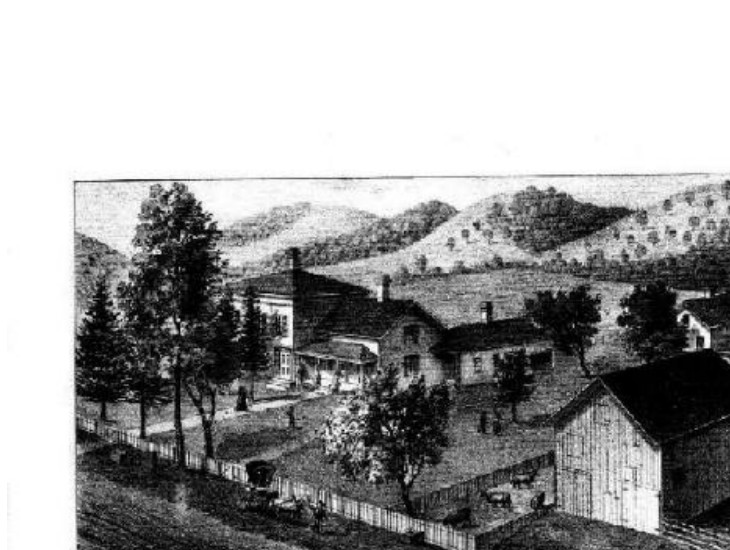
Then & now
The clay-tile roofs around the village and the ceramics college are both still there, directly descended from that 1880s clay discovery.