A dollar for a guide
In the spring of 1806 Roger Mills of Canajoharie stopped at Pike and paid a man one dollar to follow Wiscoy Creek with him toward the Genesee. At the upper falls the water power settled it. He went to Batavia and took out articles on lots 30 and 37. Judge William Peacock, who had surveyed the land, listed its animals as 'wolves, marten, deer, rattlesnakes and Indians.'
Villages on the water
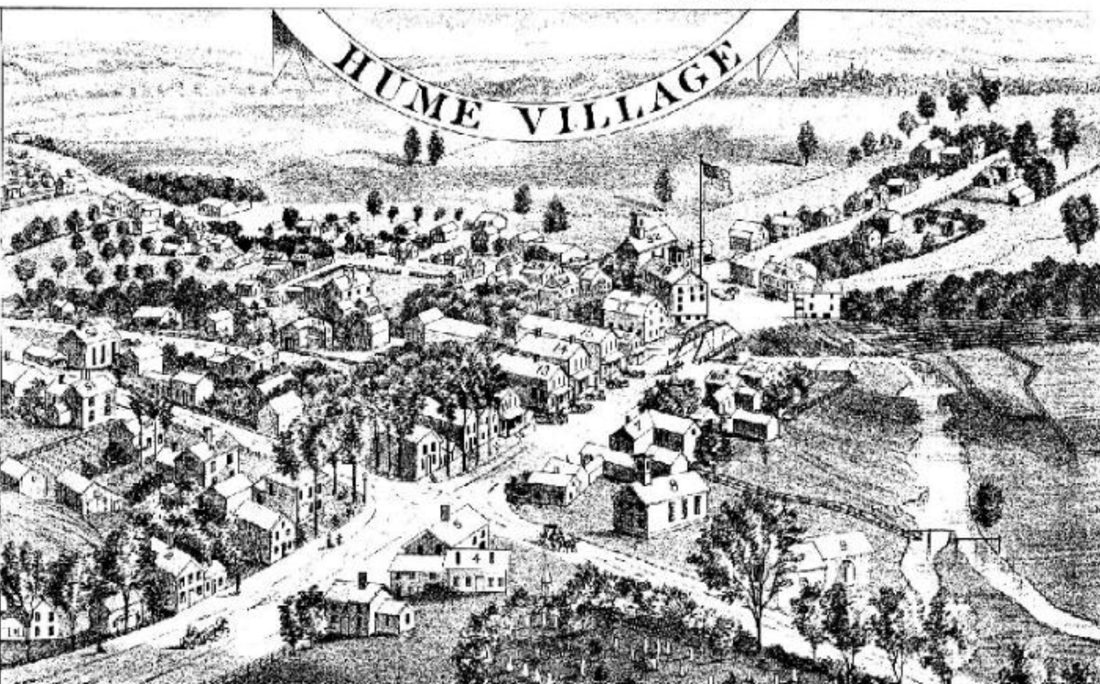
Child explains Wiscoy as an Indian name meaning 'the creek of five falls' (from John S. Minard's Pioneer Sketches). In 1875 Hume (Cold Creek), Fillmore, Wiscoy and Mills Mills were all working mill villages, and the Genesee Valley Canal ran through the east side of town.
From the 1879 county history
Read the page-cited Hume chapter selection →
- Hume was formed from Pike, Wyoming County, in February 1822. The first town meeting was held at Gardner Cooke's house on June 2, 1822, and Joshua Skiff was elected supervisor.
- The first settlement was made in 1806 by Roger Mills, from Canajoharie. He paid a man one dollar to explore Wiscoy Creek with him in search of a mill site, and the water power at the upper falls led him to secure lots 36 and 37.
- The book explains the name Wiscoy as "the creek with five falls".
“its splendid water power immediately arrested his attention”
Then & now
Fillmore is still the town's main hamlet, where Routes 19 and 19A meet.